Having seen "The Hobbit" for the second time now, I better noticed all of its defects and the things that didn't sit right with me the first time were much more prominent (thanks in part to all the complaining people have been doing – thanks a lot, guys). I don't dare say for fear of ruining it for you by pointing out things that heresofar haven't bothered you, but they stood out to me and will probably always bother me.
But I don't care! There are things about the LOTR trilogy which drive me crazy if I let them – so of course, I'm careful not to let them drive me crazy. It was FUN – and that's the important thing, right? It seems to stick pretty close to the feel of the book (plus the appendices) and there are things about it which are brilliant – so LOVE IT ALREADY! I'm making a conscious decision to avoid criticizing it in future.
Okay, so I'm not sure why exactly I decided to say that, except that there are certain conditions that make me want to write and several of those conditions are present so there you are. Yes, I did just make up the word heresofar and hey, I like it! If I separated it into three words, it would still be somewhat made up but not nearly as cool so.... I think it's a combination of hereto or hitherto and so far.
And that's my mind today – a little weird; but I'm so tired that even my dreams are about me being so tired that I can't stay awake. So my mind is a little... strange right now. And it's not helped by the fact that I have been trying to drive and just see in general without my glasses – and I think I may need a stronger prescription again... much to my disappointment. Contacts might be coming soon – much to my dad's disappointment 'cause he'll be paying for them.
And with that, I have to change so I can go accept some scholarship money so I can buy a new computer. Yay.
(If you understand the title of this entry, you're as creepy as I am – just sayin'.)
I had heard of Audrey Assad but I paid little attention. I must have thought that she was just another idol, or just another one of those shallow Chrisitian artists. But oh my gosh! I love her! Just goes to show - I didn't write her off on purpose, but you can't expect me to take every rumor seriously, can you?
Please, I'm looking forward to hear from you guys - uh, ladies. Do you like Audrey Assad?
A Movie Review and Analysis by Magdalen Aithne Arkwright
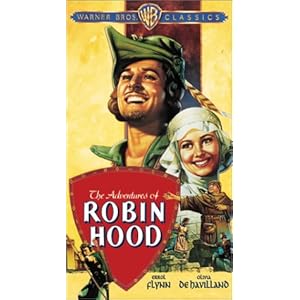
There have been many movies made and many books written about Robin Hood, all with varying degrees of adherence to the original legends. I was very pleased when I watched the 1938 Warner Bros film. I've seen bits and pieces of many different Robin Hoods, not the least of which is the beloved "foxy" one made up by Disney, but this one was different in the very feel of it.
I once had aspirations to write a Robin Hood story myself and did a lot of research about the original Robin Hood story, and found that there isn't one. The first Robin Hood tales were before King Richard's time, and in fact, the first Robin Hood legends were not even about a man called Robin Hood, but the basics of the story were similar. In most stories, Robin Hood began as a nobleman who lost his land and honor in defense of the defenseless. Some later legends include John Little, who takes on the alias "Little John" in some cases. Sometimes he has a band of merry men, sometimes not. Maid Marian was not in the original tales at all. Her first appearance in the tale as Robin Hood's lover may have been on the stages of France, but she did not start out with the name of Marian. When she became Maid Marian, she was called "maid" and not "lady" because she did not originally hold a special place of rank. She eventually evolved to be either a nobleman's ward or daughter, but her name was spelled 'Marion', the feminized version of the used-to-be masculine 'Marian'. Only in recent times has she been called "Maid Marian" and consistently been Robin Hood's damsel in distress.
In 'The Adventures of Robin Hood', starring Errol Flynn, Robin Hood starts off with a companion named Will. This is compatible with some of the old manuscripts of the tale, where Robin [of many-a-place] has a friend and fellow nobleman named Will.
In most legends, while Robin was, from the very beginning of his revolt, usually not alone, Robin Hood was frequently described as an expert bowman - even in some of the earliest tales. He was also good with a sword and, yes, a quarter staff. Robin Hood's encounter with Little John on the log crossing the river is one of the older and original tales. Robin Hood is knocked off the log and then tricks Little John into falling into the water as well.
There are even some tales of Robin Hood meeting a friar who was an excellent swordsman and adding him to the gang.
So you see, 'The Adventures of Robin Hood' is fairly true to the original tales. While some may claim, and rightly so, that the film takes liberties with history, Robin Hood has come to be, in its best form, a classic-style romantic epic.
I further liked the nobility, good will, and true care of the characters on the good side. That's not to say that the merry men weren't without their quirks and endearments, but Robin Hood was not a devil-may-care, flitty daydreamer who was out looking for danger, but instead was genuinely concerned for his fellow Saxons. I was also interested to see what they did with Maid Marion's character - Lady Marian was a proud Norman afraid to admit her people were wrong but remained, till the end, loyal to what was right. She and the Robin Hood they presented made a perfect match.
There was no profanity and had an unnoticeable amount of harsh language, but some very sensitive children may not like the action scenes. Co-starring Olivia de Havilland, Basil Rathbone, Claude Rains, Patric Knowles, and Ian Hunter.
I've watched Megamind many times, and I've seen clips of it and music videos for it many more times, and so there are certain things I've picked up on that I didn't necessarily the first time around. Since I'm also a huge fan of purple, I loved Roxanne's dress at the restaurant. Did you notice it never makes a reappearance?
In the rain, it turns blue and, it seems, never regains its original, gorgeous color. I'm talking about when she dons the dress again at the end of the movie. Did DreamWorks mean something by this? by the color? by the reappearance? Probably not. Can I surmise something from it anyway? Certainly, because even if the animators just goofed or weren't thinking philosophically about this, the coincidences can still make us think deeper about how it played out. And who knows? Maybe DreamWorks was thinking irony.
If they were, they were probably pointing out that, at the first instant, she was in love with Bernard - enough to kiss him (it seems likely to me, based on her personality, that it was her first kiss) - and in the second instant, she's in love with whom he really is.
When Roxanne so unwittingly thrust reality upon herself, she runs and her dress turns soaked-blue. What's going on when her dress morphs? She realizes that the man she's loved all along is really the evil villain of the city she's been plotting against to stop, the evil overlord of the city, the man who destroyed Metro Man. She's in shock, hurt, betrayed, and cut wide open. Everything she's believed in is a lie - and it put her at his mercy. At the time, she rebels against the revelation by dumping him, leaving him alone in the rain. The man she loved is not this alien super-villain.
So how does this further apply to the closing scene?
Well, I propose that it is kind of a reminder - whether intentionally or no - that the deception and revelation happened: Megamind lied to Roxanne, tricked her into caring about him, and then the truth came out. All of that is still true, none of it has changed. Megamind did wrong and Roxanne had every right to dump him. But now, still keeping all of that, she accepts him and, well, takes him back, if you will. The blue dress reminds us of that night in the rain - how all the other times they spent together came to a close in that moment - and brings home the fact that Roxanne has taken that and channeled her feelings for the real person behind the hologram.
Metro Man, an alien to our planet, has super powers which have made him the city's super hero. Time after time, he's stopped Megamind's evil schemes until he's a grown adult and tired of this repeated charade. So he quits.
"There had better be an amazing explanation for this."
The question Roxanne wonders is a more than fair question: "How could Metro Man abandon the city to the super villain?"
There's at least one obvious reason why he did it, and it's the one he gave us. He felt trapped, stuck in a rut, going over the same thing over and over again. It would be hard to blame him for feeling this way, since many of us feel this at one time or another. Many films and TV shows show the person experiencing this trying to make a change and get away from the situation. This is exactly what Metro Man does. He doesn't want the hatred of the city, so he basically "kills" himself. From then on, he lives a luxurious life, hidden under the old school house.
Another possible reason is he wanted to make music, but we don't know that he always wanted to do this. Really, too, there's no apparent reason why he can't make music while he's a super hero - the city would love it. That is, if he had any talent at all. Unfortunately, "You're horrible!" so perhaps it is best. Even so, however, Metro Man could have made music on his off time.
If either one of these was his sole reason, he would fail to be any kind of a hero. He would have given up, ceased to care about the city, and gone quite self-centered. It's natural to want something for yourself, but was it right for him to "quit his job"?
I propose one more possible reason.
"It took me a long time to find my calling. Now it's about time you find yours."
Metro Man could very well have been trying to help Megamind out. If Metro Man was in a rut, then the reason he was in a rut is, himself, probably in a rut too. The difference is Megamind didn't seem to notice or care, which makes sense since he was calling all the shots. So it's possible that Metro Man saw that Megamind needed to go beyond this place they were in.
So perhaps Metro Man abandoned the city. But maybe he was right to do so. It was time someone else took over, and mayhap he knew even Megamind could be the one.
"Then it hit me: if I was the bad boy, then I was going to be the baddest boy of them all!"
Megamind is an alien sent to this planet when the destruction of his own planet was immanent. But unlike Metro Man, he doesn't look like any of the creatures of Earth. Furthermore, his ship lands in a prison. His big, blue head comes with brilliant genius, but unfortunately, his genius is not properly understood or applauded. Time after time, Megamind tries to fit in, to be one of the class, but every attempt fails. Discouraged, he starts to think this is all that fate has destined for him.
Megamind decides it was his destiny to be the bad boy and promptly sets off a blue explosion in the school house, which sends him back to jail. In the voice over, Megamind boasts of a long and glorious career, but in the window in the back of the school bus, we catch of glimpse of Megamind looking longingly back at the school.
"What's the point of being bad when there's no good to try and stop you?"
Is Megamind really bad?
First we should ask: Who is Megamind?
Megamind is an alien - we've already covered that. He's a skinny, inventing genius with a passion for guns and looking cool. Since Megamind is the main character of the film, we can see his thoughts and desires, as well as his motives. In essence, Megamind is a kid, having fun and looking for attention. He's all about show and, in truth, he's a bit cliche. He doesn't genuinely wish others ill; he's in it more because it's his fate to be the villain and he's going to have fun with it.
Megamind lacks those qualities which characterize a truly black-hearted villain. First off, he's not cruel to his "minion". They're best friends and practically equals. He's "daddy" to his brain-bots. He doesn't want to take over the city for personal gain, to inflict pain, or for any other selfish reason other than winning a battle. Megamind doesn't want the money, the paintings, or the girl - he wants the fun.
"Maybe I don't want to be the bad guy anymore."
Ultimately, Megamind is lost in his own world. Attention from Roxanne makes his desires for being bad quickly diminish, and the sudden loss of those attentions brings them back again. He puts it aptly himself: "Some days it felt like just me and Minion against the world." He's different and alone, and he's fighting against the world for acceptance. He doesn't get the acceptance, but he can at least fulfill his role as villain.
I'm inclined to feel bad for him, and at the same time, be extremely proud of him: "You left us in the hands of HIM!" Let me paint the scene for you: Megamind is alone. Minion walked out. Roxanne dumped him. Titan is taking over the city. Every single plan Megamind has ever devised has ended in failure - not because he wasn't clever enough, but because he was the bad guy. ("Justice is a non-corrosive metal.") He just found out that the one plan that actually worked - a.k.a. full power of the sun concentrated on Metro Man - actually didn't work. And this same Metro Man abandoned the city to be taken over by Megamind. Everyone, including Megamind, knows that it was a horrible idea to leave Megamind in charge of the city.
Roxanne to Metro Man: "You left us in the hands of... HIM!" (to Megamind:) "No offense."
Megamind: "No, I'm with you."
Megamind gives up. He's he bad guy. He doesn't win. Ever.
And at last, Megamind shows his true potential. He sets things right, wins the girl's heart, and becomes the hero. Megamind wins the admiration of the city, the love of his dream girl, and the place in life he's always wanted and needed. Considering his background and adolescent life in prison, Megamind is a true hero.
"I'm the bad guy. I don't save the day, I don't fly off into the sunset, and I don't get the girl."
-Megamind
This often happens in "good-versus-evil". The the conflict swirls around the damsel. Every once in a while, she gets dragged into the swirl, and then she stands in the center, grinning and pulling the strings.
Maybe she doesn't realize she's doing this, but she is the one thing the villain needs to lure the hero; she is the one thing that the hero would do anything for; her decisions influence the decisions of both the hero, the villain, and other key characters.
Lets apply this premise to the new Dreamworks film 'Megamind'. Roxanne is actually a secondary character, but she is a heroine in her own right. She is smart, witty, and brave. Let's examine her character a little further. She is so often kidnapped that she doesn't really mind anymore. As for Metro Man, "he was never really my type," she says, but she certainly does love him in other ways. She's also not afraid to make it clear to Megamind that no one takes him seriously.
She's the pretty girl that brings Metro Man to the rescue. She's the bright reporter on all things Metro Man. She's Hal's coworker and secret crush. She's Megamind's inspiration.
In the start of the movie, Roxanne is set up to be, firstly, a reporter. She is first heard and then seen through the lens of a news camera. Then she's defined as a Metro Man fan: "It's time to get into the Metro Man day spirit!" Then Hal reveals to us that she's the damsel in distress that Megamind uses to lure Metro Man into traps. The audience is then left to assume that Roxanne and Metro Man have a kind of relationship, as you might expect. Almost immediately after, we find out that Hal has a crush on Roxanne, and furthermore that Roxanne is so obviously not interested in him.
As the movie progresses, she quickly turns into a would-be heroine. With Metro Man gone, she decides someone has to stand up to Megamind. Of course, Megamind is actually on her side - not in the way she thinks and, that is, she doesn't even know its him. But she, unwittingly, plays an inspiration to Megamind. Because of her optimism, he realizes he can "create" a hero to battle him, although Roxanne wasn't thinking on such an extreme level.
But Roxanne is inspiration for more than one man - and she's quite unaware of it. Hal, now Titan ("Tighten"), thinks his new powers will lure her to his side. But he makes the tactical error of being far too forward - not to mention trying to woo her just after she realizes Megamind's plan. She realizes that Titan is Megamind's creation and, still being completely uninterested in him, she tries to warn him - to no avail. And because of her rejection, he ditches the good side.
She then dumps Megamind (just after he lost his best friend in a fight) through a twisted turn of fate, leaving two men hurt and lost. Without a reason to be good, both Titan and Megamind have only one backup plan - be bad. However, Megamind is about as good at picking up hints as Titan is. While its true that he convinces Titan to battle him, Titan is still sincere about being evil.
Then Roxanne reluctantly agrees to help Megamind find a way to defeat Titan. In the process, they discover a startling revelation - Metro Man is still alive.
Now that Metro Man - the last hero - is proved to have run from the job, there are no heroes left to look up to. Metro Man hints that its Megamind's turn to be the hero, but it seems Megamind doesn't think it's possible for him to be the hero.
"I'm the bad guy. I don't save the day. .... And I don't get the girl."
Megamind has failed. Time and time again. He's lost every battle. None of his plans have ever worked - including the one he had thought took out Metro Man. He lost his best friend. He lost his girl. He created a villain more dangerous than Megamind ever was. Everything has gone wrong.
Megamind turns himself back into prison. Meanwhile, Roxanne makes one last attempt to be a heroine, but Titan's not interested in negotiating. As Megamind flips through the TV stations in his cell, Titan's face appears on the screen. "Megamind, we have unfinished business! .... Go on, Roxie, call for your hero to come rescue you!"
"Megamind, I don't even know if you're listening, but if you are - you can't give up. The Megamind I know would never have have run from a fight, even when he knew he had no chance of winning. It was your best quality! You need to be that guy right now! The city needs you. I need you."
-Roxanne
Roxanne is the damsel in distress. She's the one who gives the hero a reason to fight. Although she's rather self-dependent, in the end, she plays this role well. She was the ultimate reason Hal wanted to be a hero and then turned evil. She was the reason Megamind created Titan, the reason Megamind stuck to being bad, the reason he turned good. She was the reason good won.
Behind every hero is a girl. This isn't just some cliche - it's never stopped being true.
~Meggy
(Additional thought: Why didn't Metro Man have the inspiration to stay a hero?)
Mother Gothel found her elixir of life in a magic golden flower. Singing to the flower made her young over and over, and she lived in youth for hundreds of years. Yet, she kept this gift to herself, forcing the king to send search parties for this flower. Miraculously, the flower was found, and it healed the queen. Consequently, the baby princess was born with healing power in her hair. Mother Gothel suspected this and tried to cut the princess's hair. But it lost its power when it was cut! Mother Gothel kidnapped the princess and raised her as her own in a hidden tower.
This seems like a pretty awful thing to do, but does she ever come to value Rapunzel for Rapunzel and not just as an antidote to age?
If you've seen the whole movie, you'd probably be anxious to say no, but perhaps the matter deserves some thought first.
Let's face it, Mother Gothel is not the nicest or most selfless of characters. That being said, maybe she does love Rapunzel - as much as she could be expected to. Doesn't she want to make Rapunzel's favorite for dinner? Doesn't she agree to go on a three-day trip in order to get her birthday present? Doesn't she claim to have Rapunzel's best interests at heart?
Now we have to figure out if she really did have the best of intentions for Rapunzel. One clue is she says, "I love you very much, dear," and she seems to have sympathy for Rapunzel when Rapunzel agrees to stay in the tower. However, Mother Gothel declares that Rapunzel has to stay in the tower and must never ask to leave again - because she doesn't want to loose Rapunzel, or because she doesn't want to loose Rapunzel's hair? Could it possibly be because she thinks Rapunzel will get hurt and have her heart broken?
"I'll be back in a bit, my flower!" "You know I hate leaving you alone after a fight, dear, especially when I've done absolutely nothing wrong." (not exact quotes) After we have been introduced to Rapunzel as a teenager, we meet Mother Gothel, and her words here to Rapunzel are a clue as well. "Rapunzel, Mother's feeling a little run down. Would you sing for me, dear? Then we'll talk." She appears more interested in her own concerns than she is in Rapunzel's.
The concluding proof is her reaction to Rapunzel's revelation that she is the lost princess, and also that she keeps Rapunzel from Eugene - even to the point where she must mortally wound Eugene. It is obvious that this life that Rapunzel had discovered - her royalty and her love - are right for Rapunzel. Mother Gothel's only reason for her actions is her selfishness. This becomes quite obvious in this last scene with Mother Gothel.
So if you thought that Mother Gothel's interest in Rapunzel was of selfishness, you were probably right. It's hard to say whether Mother Gothel wasn't otherwise attached to Rapunzel, but it should be safe to say that this deeper feeling is lacking considerably.
As a side note, Rapunzel still loves her "mother", in some fashion - Mother Gothel fell out the window, but not without horror and worry from Rapunzel.
Not only is this the line everyone has been waiting for, identifying Eugene as Rapunzel's rescuer, this is a turning point in the movie Tangled from Disney.
Flynn (Eugene): "Listen, Blondie-"
Rapunzel: "-Rapunzel."
Flynn (Eugene): "...Gesundheit."
And from here on, Flynn calls Rapunzel "Blondie" - that is, until he arrives to save her. "Rapunzel? Rapunzel, let down your hair!" This moment makes it clear to everyone that Flynn has become Eugene for good. The lantern scene wasn't a dream - it was real, and Eugene really does have a new dream.