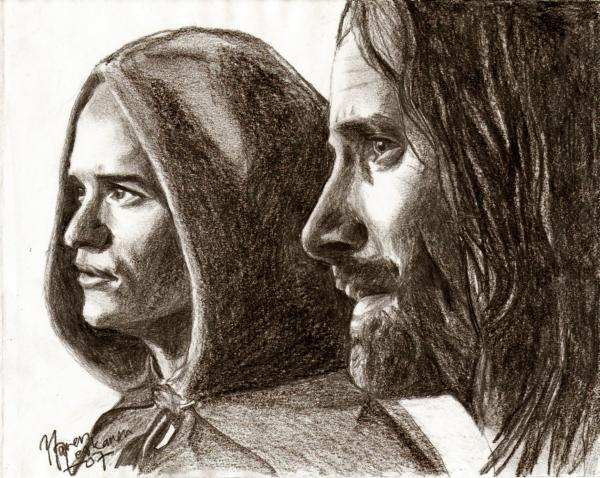
I picked Spock as the character that I studied. He is quiet and careful in his choice of words. He is loyal and knowledgeable, but naive and doesn't understand when logic doesn't get the job done. At his best, I found him to be a cross between Thomas Aquinas and the Little Flower, but obviously he doesn't have their level of virtue.
I had other characters in mind as well, but as we go into August, I can see that I don't have time. If you're lucky, you might get an analysis of a LOTR character but I am rapidly running out of time.
Did you pick a character and do one as well? If you have no idea what I'm talking about, try reading Learning to be Like Your Favorite Characters series explained and the first in the installment: Supplementing Your Summer: Character. If you did this, please tell me about it! I haven't had much time to study any other characters (so it'd be great if you did the work for me...) and I'd be interesting in seeing what you've come up with. TV show and movie characters are the easiest because it usually takes a lot less time to watch something than to read and study a book. Even so, books and even comic books are allowed in this game.
If you haven't done this, I would like to take this opportunity to encourage you to do so. It is really quite fun. Emulating people I admire has always been part of my character, more so than in most other people, I'm realizing, and so this process of analyzing character may be easier for me than for some other people. Even so, I think you might find it fun!
(I should mention that my Book Binding posts have been delayed due to unforeseen circumstances. I will give you the last installment as soon as I can.)
I hope you had a pleasant summer, and may the rest of it be bright and gay!
~Meggy
Quick to leaf, you'll come to grief; slow to shoot will bear you fruit.
No tricks, really. This is not like "You're a bus driver in New York City. At the first stop, ten people get on. At the next, four get off and three get on. Then eight get off and eleven get on. What is the name of the bus driver?" This is not like that. It really is just pure logic, as you may expect of Einstein.
1. In a street there are five houses, painted five different colours. 2. In each house lives a person of different nationality 3. These five homeowners each drink a different kind of beverage, smoke different brand of cigar and keep a different pet.
THE QUESTION: WHO OWNS THE FISH?
HINTS
1. The Brit lives in a red house. 2. The Swede keeps dogs as pets. 3. The Dane drinks tea. 4. The Green house is next to, and on the left of the White house. 5. The owner of the Green house drinks coffee. 6. The person who smokes Pall Mall rears birds. 7. The owner of the Yellow house smokes Dunhill. 8. The man living in the center house drinks milk.
9. The Norwegian lives in the first house. 10. The man who smokes Blends lives next to the one who keeps cats. 11. The man who keeps horses lives next to the man who smokes Dunhill.
12. The man who smokes Blue Master drinks beer.
13. The German smokes Prince. 14. The Norwegian lives next to the blue house. 15. The man who smokes Blends has a neighbor who drinks water.
Einstein said that 98% of the population would be unable to solve it. I did. Can you?
~Meggy
(Post your answer. I'll let you know if you're right or wrong and post the answer in two weeks. Persevere! If you just keep trying, you'll figure out which inputs result in desirable outputs.)
We're coming up on August now and school is only about a month away. I have an uncanny interest in things normal people tend to avoid, and as such, I have been brushing up on my algebra all summer. I have not taken a mathematics class since my sophomore year in high school and I am finally over the trauma. I have actually found it even more interesting than I expected.
If you have an interest in mathematics or you want to brush up before school starts, I'd like to recommend a couple good site I've been using.
If you open any hardbound book and look at the binding, you will notice that the cover and the binding are not one. This section that I cut from the manila folder, which I will call "the binding" for reference sake, is basically the binding that you see in the hardbound book. I attached the pages to this "binding" and then glued the binding to the spine of my cover.
To attach the pages to the binding, I basically continued with my sewing idea. I poked a hole in the binding with the threaded needle, threaded the needle through the top hole on a section of pages, out through the bottom hole, and then poked another hole in the binding. The main things to keep in mind here are that the binding and the pages should line up, so either cut your binding longer than you need and trim when you're done, or line up the binding and some of the pages and then poke the hole approximately where the hole is in the papers. Another thing is to consider your pages. Before I assembled the pages to the binding, I put an entry on the first page of what will eventually become a journal in order to get a feel for how the pages would work. I was satisfied and began to assemble. However, if I had not been careful, I could have put this section in backwards, at the end, or in the middle, thus having an entry from July 2012 after later entries - somewhere in the middle of the book. If your pages are embossed or are pre-written or otherwise directionally limited, make sure that you apply the first section to the correct edge of your binding.
Further notes on attaching the pages to the binding - since I had eleven sections, I sewed three sections of pages into one set of holes on the binding, leaving me with two left over, which I then sewed on separately. In order to explain this, I should further explain my procedures:
Reacquaint yourself with the beginning of the paragraph two paragraphs up. Basically speaking, referencing the above picture, I ran the thread through the binding, through the paper, through the lower hole in the paper, and back through the binding, and then brought the needle back up to the first hole in the binding, pulling the thread tight, stuck the needle back through the first hole, and proceeded as before through a new section of paper. I attached a third section of paper this way, tied a tight knot near the lower hole so it wouldn't slide, and then poked another hole near the first one to sew on three more sections. Can you see, although it is now glued to the cover (on the right), that the paper (on the left) is sewed to the binding (the slip between the two sections)? You may notice that either end is loose (in this photo, only the top edge is visible). It does not seem to be a problem, but you could also sew closer to the edges.
I did not measure the width of the binding and divide it for four holes of equal distance. Looking back, I do not regret it. I knew that it would be a comfortably tight fit with all the pages on the width of the binding so I put the first hole near the edge, the second hole close to the first, the third hole a little further away because the bulk of the pages was in the way, and the last in the most reasonable spot due to the space left on the binding and the bulk of the pages. You may not find that it is so easy for your project, I am not sure. However, if you try spacing the holes evenly, let me know how it turns out.
Once all the pages were attached to the binding, I simply held the pages against the folder (that would become the cover) up to the light and drew a sloppy outline, leaving extra space around the edges. I then cut the rough outline on the folder. Even now, the cover does not have perfectly straight lines. This is because I have not quite decided how to finish the cover, so I will leave the trimming until later (which I will get into further detail later).
I then went down into my father's workshop and found the super glue. Super glue is very strong and dries super fast. To me, it was the most practical and logical choice of glue, especially since it was available to me. Any suitable glue would work, I imagine, but may not be as strong. Certainly, you'll have to wait for most other glues to dry. I was, understandably, unwilling to wait for regular paste to dry, and I had no reason to.
I applied as much super glue as I could muster out of the bottle onto the binding and carefully pressed it into place on the inside of the spine of the cover. Depending on what your super glue bottle is like, you may not need to be so liberal. "All that I could muster" was not much since the bottle was designed to excrete only small amounts at a time and it was hard to get any even when it was full. By the time that I had pressed the binding to the cover, some of the glue had been rendered useless so I just gently applied some more in between the two surfaces and pressed them together in whatever way I could.
This is the result. The manila folder had not one but two extra folding lines, so I have a rather classy extra fold on the front.
The edges of all the pages are not even, which is due to imperfect folding, layering, and sewing, and I think I intend to let it remain so. It adds character, but I don't see any reason why you couldn't trim the pages to be even.
[music at the bottom] Would you like to make your own book? It's really rather simple, but it takes time and patience. I used a manila folder, and found that along the fold, there was an addition fold line, so that you could thicken your folder and create more room for a bigger bulk within. This came in handy for the design of the book you see in the photos, but you could easily take another folder or similar material and fold it to make the spine that you want. In fact, you could use something completely different for the cover, but this was all my craft supplies could allow. If you have a good suggestion for covers, let me know!
I should begin by saying that this design came about rather by accident, and that it is not finished. I intend to apply a design to the cover, but my plans include a picture I found on the internet and our printers are not functioning properly. However, I will walk you through the steps as coherently as I can, given that I rather made it up as I went along and there were many adjustments as the plan began as a handmade spiral bound and soon became what you see here.
I have an entire box of papers that measure four-and-a-half by eight-and-a-half inches and they come in four different colors: off-white, off-pink, off-yellow, and off-orange. I chose to use all white, although I thought about making each section a different color. Arranging them in bunches of four, I folded them in half and made a pile. I believe I ended up with about eleven bunches of four, folded in half, which comes to eighty-eight pages if I calculate correctly.
Lining them all up evenly, I marked them with a sharpy along their folded edge at the inch markers, because they were four inches wide. This gave me three dots along the fold, which I then poked through with a regular sewing needle and double thread (which may not be the correct term for folding the thread through the needle and tying the ends together). I first poked through the middle hole, went up through the top hole, again through the middle whole, down through the bottom hole, and then again through the middle hole. I did not take pictures while I was doing this project but I believe this to be fairly straight forward. It is a figure eight through the holes and it is commonly used in projects to stitch paper together.
Often times, people will put a whole lot of pages into one bunch and sew them together that way. This is efficient if you have only a half-dozen pages or so, but not if you intend to have as many as, say, eighty-eight. Instead, I did each bunch of four individually. Threading the needle under one section of our "figure eight", I put a knot in the string and pulled it down as close to the nearest hole as I could to secure the pages to together permanently.
When I got through all of them, I cut a section out of the fold of the manila folder, cutting along the given fold and one of the extra fold lines. I had previously determined that all the pages could fit within the limits of this section. Therefore, I continued to sew.
Because of the detailed and complicated nature of this post, it will be in parts. Part II tomorrow.
Yes, Spock once more. Episode Operation: Annihilate! is an interesting episode with potential. There were things I was disappointed with, but what I found most interesting was, in fact, the suffering. The neural parasites used intense pain in order to force their subjects into submission. Although it seems that there was always some kind of pain with these parasites wrapped around every nerve in the body, they could, somehow, implant an idea into the mind of their victim and then increase the level of pain to the point where the subject was almost on the brink of insanity.
In this episode, almost all of the Federation men on the planet are dead, or are by the end of the episode. Your favorite man Spock is attacked by a parasite and, consequently, is subjected to enormous amounts of pain. Although not one of my favorite episodes, it brings up an interesting point. Spock, ever the unconquerable hero, refuses to give into the pain. Already infected, he volunteers to further studies of the parasites and their effects on the planet. He is obviously in a lot of pain, but he tries not to show it, and he won't give into it.
As Christians, we know that pain will come, and we know that we're supposed to bear it with patience and silence. And it got me wondering. How often do I complain unnecessarily? Even when I'm alone, I can complain to myself. What good is this? It shifts your focus onto your pain, which always makes it worse, you know.
And then, what about other troubles? Do we unnecessarily complain about that too? Maybe, we need to learn a little silence....
An extra little interesting note: pain and suffering tends to get worse the more we give into it. If you compensate for, complain about it, dwell on it, you're thinking about it much more than is necessary, and if you're only thinking about the pain, it gets to feel worse than it is. Or, at least, it feels worse than it needs to. "Pain is a thing of the mind." Over the past few days hiking in Acadia, I find that is very true. I just avoid thinking about the pain, and then it isn't a big deal.
Fortuitous - an interesting word. I find words as interesting, perhaps more so, than any other subject. I use "fantastic" and "fabulous" most often in relation to their root-words of "fantasy" and "fable" respectively. Notice that fortuitous looks like fortune. I got the following from my dictionary:
ORIGIN mid 17th cent.: from Latin fortuitus, from forte ‘by chance,’ from fors ‘chance, luck.’
USAGE The traditional, etymological meaning of fortuitous is ‘happening by chance’: a fortuitous meeting is a chance meeting, which might turn out to be either a good thing or a bad thing. In modern uses, however, fortuitous tends more often to be used to refer to fortunate outcomes, and the word has become more or less a synonym for ‘lucky’ or ‘fortunate.’ This use is frowned upon as being not etymologically correct and is best avoided except in informal contexts.
Gardening is one of my greatest pleasures. It's hard work, but I'm not afraid of hard work. In fact, I thrive on hard work. I think most of us do. And it's so rewarding. It's like raising children, only plants get fresh in a very different way, and it's faster. Some plants yield edibles that taste better than anything you ever bought at the store. Others just bloom into the most beautiful forms you've ever seen.
Mmm, strawberries. And wild blueberries, I've found, are tastier than any you can pick at a farm (and certainly better than the ones you buy at the supermarket). Corn, I hear, loses its flavor quickly. We all know how fun it is to pick peas and string beans.
A word of caution, however, to the wise, and those with open minds and hearts - gardening is a very competitive sport. Alright, so gardening is not considered a sport anywhere on earth, but it can get very touchy. Every gardener seems to feel that their way is the only way. Whether they use chemicals as pesticides or fertilizer, or whether they use mulch, compost, or manure, everyone seems to feel that not only must they share their experiences with you but that you must also cling to their words as high wisdom from heaven. You must plant when they say, you must build a greenhouse, you must start seedlings indoors, you must water every day - oh, no, wait! only every other day, you must put up chicken wire, you must, you must, you must.
Ugh. Anyway, if you want to take credit for even one plant, be prepared to listen sweetly, with a gentle smile on your face, nod, and thank everyone you meet who has ever planted a seed for their advice. Of course, as we all know, we should always be open to listening and seriously considering what ever anyone says, in case they're right. But it does get frustrating after a while.
Here's a good rule of thumb - people have been gardening for a very long time. Okay, that's not really a rule to garden by, but it puts things into proper perspective.
It must be possible to grow things with just the stuff you can find around you. Granted, if you have no knowledge of what conditions a certain plant likes, facts are best unless you want to take the long route of try and fail. Otherwise, most plants don't need extra special treatment that only the privileged few (namely, everyone, but you) knows about.
In many areas, even now, in July, you can still plant some vegetables outside. Corn, for instance, is grown in two cycles in my area. Beans and peas are a good bet. Tomatoes! But even if you can't plant new vegetables, there are plenty of flowers that are just coming into season or will be in autumn. Put in some new flowers, trim back some bushes, do a little hoeing and/or weeding, and voila! Look at the beautiful garden you've got!
But even if, for whatever reason, you can't have a full-out garden, you can grow some indoors. Some excellent indoor plants are:
bleeding hearts
day lily - although lilies love sun, they are generally very hardy plants and can thrive in most conditions; if they have a few hours of sun, they should be okay
forget-me-not
periwinkle
If you have any other tips or need me to clarify something, leave a comment!
For the next few days, I'm going to stick with Spock, but feel free to pick a new character of your liking. Continue analyze aspects of his character. This time, try to think of something he said or did that caught your attention. Do you agree with it? If not, why? If not, pick something else. If you do agree with something he said or did that stood out to you, could it benefit your life if you applied it to your way of thinking?
This clip cuts short too fast. What we don't get to see in this clip is Spock spitting in Sarek's face, metaphorically speaking of course. But Spock says, "I'm not the cast-off kid you left behind all those years ago," or something to that effect. "I know who I am." He knows what his father feels, knows that he's half human, knows that that's just how it is. He's come to grips with it. And, if I may say so, does wonderful things with it.
You always have to take what McCoy and Kirk say as a grain of salt. In fact, Spock says some things once in a while that are too simplistic, and I hope you can recognize those moments. What Kirk says in this clip about needing our pain, about our pain making us who we are, is to an extent true, isn't it? It is because of our trials, failings, and sufferings that we have become who we are. Star Trek episodes from the original series and in the later series have explored this concept, but basically, what we've had to encounter and the sacrifices we've had to make have developed our characters.
However, we need to let go. We can't be obsessed like Doctor McCoy is about cutting the chord on his father. They don't make it clear whether McCoy just stopped life support or actually killed him, but either way, it eats at him, makes him sick. He couldn't save his father, couldn't take away his pain, and not long after his father's death, a cure was found. Sarek tortures Bones with it, I believe calls it murder, and then tells him to let go. The result, as is the result with much of the crew, is that McCoy almost sees him as a kind of god for a second. Sarek has the interesting ability to take away pain, and so McCoy feels free from his pain. But what happened has not been undone. McCoy loved his father and did what he did because he loved his father. We don't get to see Kirk's pain, and since he is the strong captain who is not supposed to have any weakness, that is appropriate. But he says he needs his pain.
Spock has sort of the middle road between completely forgetting pain and clinging to it. He has his pain, but he has accepted it.
So how can I apply that to my life? I certainly have plenty of painful moments in my past, some greater than others, a few that will likely always be my weakness. But can I come to grips with it? Forgive the causes of my pain and suffering, know that it has happened, and, with solemn reserve, look to the future?
Yesterday's Sunday readings were fascinating. I have been contemplating this concept, and for a few months now I had been struggling with one thing in particular and now I tried so hard to let it just sink into who I was and stop fighting it. Then I heard Paul's letter to the Corinthians. Obviously, the three readings yesterday have a sort of connection, and there are other things to be learned from the readings yesterday, but monsignor even made this reading the topic of his homily.
Brothers and sisters: That I, Paul, might not become too elated, because of the abundance of the revelations, a thorn in the flesh was given to me, an angel of Satan, to beat me, to keep me from being too elated. Three times I begged the Lord about this, that it might leave me, but he said to me, "My grace is sufficient for you, for power is made perfect in weakness." I will rather boast most gladly of my weaknesses, in order that the power of Christ may dwell with me. Therefore, I am content with weaknesses, insults, hardships, persecutions, and constraints, for the sake of Christ; for when I am weak, then I am strong.
There you go! Not only is Spock content with his weakness, but Saint Paul says that it is God's will!
So I'll be working on this concept for the next couple of days. What about you? Who did you pick, and what are you focusing on? Consider this a tag of sorts - to everyone. Comment here, or write your own post and let me know - I'd be very interested to hear your insights about our favorite characters.
So part of this summer fun is analyzing your favorite characters and getting to know them better. Doubtless, some of us will have to face up to the facts and our hearts will be broken along the way, as we realize and accept things that we did not want to know. It would be illogical, however, to deny the facts, so know that I have been there and I am empathetic to your woes.
Remember as you're doing this, that, although an actor or author has given your character an appearance and a charisma, he (or she) is not that character that you love so much.
So over the next few days, weeks, whatever, try to emulate your favorite character's characteristics. You might learn some new things about him/her.
As you may have picked up on, a character that I have grown very fond of is Spock from the original series of Star Trek. There are a few obvious traits about him, such as his stubborn (yes, stubborn) adherence to "logic" and rejection of emotion. (Anyone who knows anything about Star Trek knows that Vulcans are not devoid of emotion, they just try to ignore it.) It may well be that Vulcans are "wired" so that devotion to unemotional logic is somewhat more natural to them than it would be to humans (although considering their ancient past, that is illogical), but Spock is half human and so a human's need to a healthy release of emotions is sometimes very pressing.
Something that I have found while practicing his logical approach to life is that Spock is actually very naive. Sometimes, there are situations that you can't handle with a simple, logical equation (that isn't to say that logic isn't practical). I don't know if it would be different if he was not trying to deny his human side, but I do know that as he is, he does not at all understand anything about the people he deals with every day, even though he is probably the only Vulcan with such an opportunity to understand them.
The clip from this episode that I wanted had more to do with when they start
laying the heat on Krako - Spock is just hilarious! - but this one is very funny
I have also learned that logic is not a thing of children, so don't bother trying to use it on my little sister.
However, it came in handy last night when I was tired and we stayed at a friend's house an hour longer than I was emotionally prepared to handle, the whole day was boring for a July 4th, and then we almost didn't see any fireworks at all. I was on the verge of degenerating into an emotional mess (please believe it was because I was tired and disappointed, and not because I'm a spoiled brat) - but that wouldn't have been logical. ;)
The danger is that, in using logic, you could simmer everything down to "literal". These are not the same thing. Another danger is finding increasing annoyance at the ridiculous and irritating things said by some people who will remain nameless. But to lose one's temper and accomplish no more than if one had kept it, and in fact possibly make things worse, would be illogical....
~Meggy
There are better videos out there, but this one has the full song. I've yet to see
a video that actually shows Spock saying "illogical" when Nimoy sings it.
If you find the above downright easy, or when you do, it may be time to move on to something a little more complicated, and I know nothing better than ballet exercises.
First, to get the most out of the following, I would recommend that you stand in first position and do some plies, with your glutes tight, working the rotation in your legs (do not rotate from the ankles: a.k.a, turn your leg out from the hip and do not force your foot any further than that!).
You needn't go all the way down to grande plie
Okay, so first exercise:
That's a passe, and it's not too hard (don't lean over as far as the rightmost girl appears to be). (If you wish, you could try this with your leg turned in, so that it points straight out in front of you.) Remain tall - let go. Hold. As long as you can, and remember to hold control, even when putting your foot down. Too easy? Try it on releve:
Unless you're a dancer or perhaps a gymnast, you probably won't be able to get up on releve that high^, and that's okay (it comes with a lot of practice and time). But the higher your heel and the straighter your leg, the less likely you are to strain something and the better your balance will be. (If you want to improve your strength, put the ball of your foot on the edge of a stair and rise all the way up and down.)
Anyway, in releve, try the passe again. Keep doing this until you're solid (30 seconds would be a good goal, but start small). Some tips:
- remember standing up tall and lifting yourself from the crown of your head? Vitally important here.
- And be constantly lifting the leg in passe from the thigh toward the ceiling (not with your hand). It keeps an up momentum. But keep your big toe lightly touching the side of your knee
- Think "up" if you have to!
- keep your upper body lifted! If you sag, it's like holding a sleeping baby - heavy
.................................
If you make it to this point, congratulations! Now, in releve, coupe. I suggest doing it front of your ankle:
If you can stand in releve like that, "extend out" - stretch your leg out to the side without collapsing! Remain at all times lifted to the ceiling!
*wipes brow* Whew! If we get threw these to the point of ease, let's move on. ...But till then, let's just do these over and over and over and over and over and over and over and over and over........
You could also try doing these while standing on a pillow, brushing your teeth, stirring a pot on the stove, etc..
If you have any other tips or need me to clarify something, just comment!
This should be a rather brief as the concept is really quite simple. Let's see if I can keep it that way. (song at the bottom)
Skip ahead in the above video to about 5:00 and watch the scene with Mr. Collins. Do you see how the ladies simply sink down into their chairs? And yet, sink isn't the right word. It's more like they are floating down like a feather.
One of my etiquette books has once said that you should lower yourself, still erect, into a chair.
I couldn't say it better than this: (click anywhere in the following to be redirected)
*Note: The name of this series has been changed to 'Supplementing Your Summer' The following still applies in so far as we will be examining our favorite characters (7/5/12)
What is it that I am trying to accomplish exactly? I am not sure, and I do realize that sounds illogical (my new favorite word). My mind is saying that I am trying to further develop virtues and good habits in my personality. My heart, however, is telling me that I am actually trying to be those characters. This is partially true, and when I am so suddenly fascinated and captivated by them, is it all that surprising?
The truth is, this began when I realized that I haven't been all that I should be lately. Part of the reason for that is evident by my urgent desire to simply put my head down and close my eyes only a few hours after getting up this morning. I am tired beyond a reasonable capacity at this point. Everything I think is fuzzy, everything I do is slurred, and I can't even see clearly across my bedroom anymore (I knew I was nearsighted, but not that much!). But this is all irrelevant.
I have had past experience emulating people I admire, and I find that, over time, I have been quite successful in ways that I did not expect. In trying to be more like someone else, I have found myself more deeply. Mainly, that is because I seem to be incapable of literally being someone else for long periods of time, thank the Lord, and only capable of applying their perspective of life to the incidents in my own life.
This way of approaching life has encouraged my view of my life as a fairytale, but I have come to the conclusion that life does not come that way. You are a heroine (or hero) only if you want to be. In many of the pieces of literature I was assigned in high school (was! how weird a feeling), there was a focus on the difference between the protagonist, the antagonist, and the "common man" (for a prime example, read 'A Man for All Seasons'). You can be Saint Thomas, you can be someone like Cromwell or the King, or you can be any one of the numerous people who stood by and watched as life's opportunities passed them by (by opportunities, I mean chances to change history forever and be a hero, not chances to make lots of money and be famous).
You may imagine how excited I get when I begin to pretend to be a fantasy character. Yes, I see that is what I am doing, pretending. Perhaps you do not think that is healthy, but it has made me who I am. It has fueled my interests, made me a stronger person, helped me be more determined in achieving my goals, and I now value many unconventional things because of my wish to be like people I look up to.
I think that is normal. Do children not imitate their parents? The fact that I have a melancholic temperament and I connect on a deeper level with characters that are quieter and more reserved, and want to be like them, is just part of a natural process. My personality sees a deeper, fuller manifestation of itself in others and, in quite a natural and blameless way, wants to be like that.
Do you understand?
Because I am melancholic (and I use the term not, as some do, like a religion but rather to explain my personality to you), I admire characters like Samwise and Frodo, Captain Kirk, and women who plow the way for future generations of women, but I don't have any desire to mature to their level. I connect with characters like Aragorn, Spock, and the little nun who does things in the background. I understand where they are coming from. I could be a leader, and often am because of my place in life, but I prefer to support the leader. I've got your back. (A very logical feminine trait, don't you think?)
Being a fanatic about something, especially someone, can be very dangerous, as we have seen, and trying to be just like them is often a problem. But do you see why it isn't in my case? First of all, I can, albeit sadly, distinguish the character from the celebrity. There was one case, only a couple years ago, when I suddenly became attracted to Adam Lambert because of one of his songs. My actions were suddenly fueled on passion and, well, everything that screams Adam Lambert (or rather, everything that Adam Lambert screams). Although I was on the brink of making some poor decisions based on my fascination with him, it was not long before I came out of it, and I have learned to be a little more outgoing and confident because of it, but as you can see, I am not an identity-confused punk. I came out alive, praise be to God. Because I have a good home and upbringing, my idols, up until that point, were safe and moral people. As long as you pick virtuous characters and are aware that everyone has their flaws, I think that developing like characteristics is a good thing.
Can you imagine any bad effects of trying to be more like Aragorn in your own life? Yes. You could try to carry around knives and swords, dress in strange clothing, abandon everyone who holds you dear, and go for weeks without a proper bath. (Did anyone besides me think of the era of the hippies? No offense to hippies meant.) Obviously, applying "Aragorn" to your life does not mean apply your life to Aragorn. You are not trying to bring him to life again so he can live in your world. You are trying to bring his values to your life. It is the same as a role model such as a Confirmation sponsor, parent, friend, or saint. Do you think novels are purely for entertainment purposes? For moral lessons? I think they speak deeper than that, should teach us something about ourselves, and if they don't, they are rarely worth the time.
I have a few more boring posts in this series to publish which mostly continue the subject of posture so that you and I can acquire a more formidable appearance. (After all, does your favorite character slouch?!) After that, I intend to focus mainly on dissecting characters and doing fun things with the insights we discover. Being who I am, I will probably focus on aforesaid characters but I will try to keep the topics broad. I might cover anything from picking one main characteristic to work on to skills like archery or herbology. There will be a general fantasy theme, however.
Whether you are an Aragorn or a Sam, a Luke or a Han, Blanche or a Rose, I think this will be an interesting experience.
In this field, as in any field, I am not an expert. In fact, of all the topics I've covered, I probably know less about this one than to I do about any of the others.
Some tips for walking from my own experience:
Start by just standing - and remember to stand tall. Now, if you're like a great deal of the population, you stand on your heels. But maybe you don't if you're a dancer or you've practiced "walking on the balls of your feet." Feel where your weight is while you're standing. Put your hand on something to make sure you don't lose your balance (although that's something you should work on), and lift the balls of your feet. If you can do that without rocking the rest of your body backwards, then you probably stand on your heels.
Go stand in front of a mirror and stand tall (as always) with your feet straight and slightly apart. Look at your full profile. You look straight, right? From head to toe. But now lean forward (right from the ankle, don't bend at the waist) until you're about to fall over (notice that the weight has left your heels). Now lean back - but not all the way! Just until your heels are resting on the floor and are supporting you, but you aren't leaning on them. All the weight should still be in the balls of your feet. If you were to go from "heel standing" right to "ball standing", the difference would be about an inch really - but it feels like a lot more. If you look back in the mirror, you're still straight!
From what I can tell, this takes the brunt of your weight out of your lower back, knees, and calves, and into your thighs.
Now start walking with this stance in mind. It gives you a kind of forward propulsion. By now, you should be walking with amazing grace - so to speak.
Actually, if you read the following article on About.com about running, it gives you great tips even for walking!
I should mention that when articles such as this say not to tuck your pelvis or to "keep it neutral", they don't mean to ignore it. Quite the contrary. It's one thing to jam your hips by tucking it under or to let it stick out in back, and quite another to hold it under you (mainly with your abdomen).
Okay, so breathing is definitely important. Not only is it part of what is keeping you alive, it can also consume a lot of the energy that it helps create. Here's an exercise. Lie down and feel yourself breathe for awhile. Put one hand on your chest and one hand on your belly. You feel that? Now stand up again, and voila! Your breathing is back in your chest.
Well, ideally, you should be breathing from your belly. How do you do this? If you're a singer, you can basically skip this part. Some athletes might already know this too. It was important to first learn good posture because, chances are, if you're standing up tall, your ribs are wide open. Try standing up tall with your shoulders back so that your arms match the seams on your clothes. Now put your hands on your ribs and pull your shoulders up as high as they'll go. Do you feel how your ribs expand. Now drop your arms and see if you can "close" your ribcage, as in try to make it as small as you can (you may find your abdominal muscles engaging). Well, for breathing purposes, it'd be pretty hard to keep your ribs as wide as they are when your shoulders are up, but you don't want your ribcage to be closed for effective breathing.
Try to expand your ribs without using a huge gasp of air to do so. (Remember, your back should be straight, your shoulders back, and your chest up.) Now start breathing without moving your ribs in and out or your chest up and down. Lie down again if you need to get the feel for breathing in your belly.
Again, this is something that is going to take time getting used to. But say you take a long car ride - practice! What better time? You're not doing much else!
(There is a song at the bottom if you'd like to listen while you read)
Okay, everyone, 'Brave' is out today! I'm going to see it tomorrow with my family. Everyone I know is looking forward to this great movie!
As you may know, although I don't talk about it often, I have a real respect for characters and creatures that are wise, quiet, and wise. Oh, wait, I said wise twice. Well, that's because they're twice as wise as they are are quiet. My romantic sense also loves adventure because of all the fairytales and fantasies I've read. My admiration includes elves, rangers, Vulcans, and now Scots! Yep, and all thanks to Merida. Oh, and it may have something to do with the fact that my mother is a descendant of the MacArthur clan.
Anyway, because I have such a passion and, if I may say so, a knack for emulating these sorts, I think that, in celebration of 'Brave', I will spend the next month or so working on the traits that characterize these folk. Would you like to join me?
The first step is easy to single out, and even I, who have worked on it since I was a wee bairn, need to practice. I'm not the first to point this out, and it's often top of the list when you read anything on "how to be an elf", but it is perhaps the most important thing! We all know that elves and especially rangers, do not go around creating earthquakes. Look at Legolas! He was walking effortlessly on top of the snow! Or was it effortlessly? What are the chances that it takes effort, even for an elf, to do that?
Anyway, first step is to learn how to put your weight on your feet. Some people will tell you to walk on the ball of your feet, and that's good advice but let me clarify. You aren't walking on tip-toe. Your heel hits the ground but it's like instantly transferring the weight from your heel to your toes. But perhaps you should first learn how to hold the rest of your body. This article on how to stand like a ballet dancer will help you get started:
One of the first things a ballerina learns is how to properly hold her body. One of the distinguishing factors of a ballet dancer is outstanding posture, while dancing or not. You can find your center of balance by imagining a straight line running through your spine. In order to achieve the proper stance, ballet dancers must practice every day. In the beginning, you may find it helpful to lightly hold a barre for balance. The following steps will help you stand like a ballerina.
Time Required: A few minutes each day
Here's How:
Stand with feet in first position, heels touching and feet turned out, with knees straight.
Pull in the muscles in your tummy.
Tighten the muscles in your bottom and flatten your back.
Pull up the muscles in your legs.
Widen the shoulders, pushing them down and back.
Hold the arms down in front of the body, with elbows slightly bent and hands soft.
Lift the chin, lengthening the neck.
Breathe deeply and relax.
Tips:
Keep your shoulders down and open.
Look up and out, never down at your feet.
Glance in a mirror to check your posture.
(Obviously, this is how a ballet dancer should learn to stand in "first position" and so some of the tips will be unnecessary for your purposes, but it actually will give you a good idea of how controlled ballet dancers keep their bodies, and will help you get the feeling of how to hold yourself. It will also tone your abdomen and glutes.)
Ideally, what you should be thinking about is lifting yourself off the floor, right from the top of your head. Yes, this is going to be hard at first, probably harder than you think. It takes an incredible amount of energy to keep your back straight for long periods of time, but if you keep practicing, you'll get stronger. A good goal is to stay perfectly straight all through dinner - even if you thought you were sitting up straight, you probably weren't! This article is great but is too long for me to post here (you don't have to worry about seeing or reading anything on this site).
Kitty may actually have the best posture -what do you think?
Okay, that'll do for now. The main points to remember are to walk like you're floating on air, to keep your back straight and tall, and to tuck "under" your lower back (sit down and sit tall, then tuck your pelvis under and try to make your back as flat as possible- see how the pressure sifts?)

 I picked Spock as the character that I studied. He is quiet and careful in his choice of words. He is loyal and knowledgeable, but naive and doesn't understand when logic doesn't get the job done. At his best, I found him to be a cross between Thomas Aquinas and the Little Flower, but obviously he doesn't have their level of virtue.